

Moving abroad is a major life decision, and Portugal has become one of the most popular destinations for people who want a fresh start in Europe. Before packing a single bag, though, every applicant needs to understand the Portugal immigration process from start to finish. This guide breaks down the official requirements published by the Portuguese Ministry for Foreign Affairs so you know exactly what to expect at each stage.
Why So Many People Are Choosing Portugal
Portugal offers a mild climate, a lower cost of living compared to many Western European countries, welcoming communities, and a straightforward path toward long term residency. Whether the goal is studying, working, joining family, or simply seeking a better quality of life, understanding the Portugal immigration process is the first and most important step. Applicants who take the time to learn the rules before they apply tend to avoid delays, rejected paperwork, and unnecessary stress.
The Two Main Categories Of National Visas
According to official guidance, long stay visas fall into two broad categories depending on how long the applicant plans to remain in the country. The first category is the Temporary Stay Visa, and the second is the Residency Visa. Both are part of the same overall Portugal immigration process, but each one serves a different purpose and comes with its own set of rules.
A Temporary Stay Visa is designed for people who intend to remain in Portugal for more than ninety days but less than one year. This type of visa allows multiple entries into the country and remains valid for the entire length of the authorized stay. It is commonly used by seasonal workers, medical treatment patients, interns, and people completing short academic programs. Anyone following the Portugal immigration process for a temporary purpose should confirm early that their intended stay actually fits within this window, since choosing the wrong visa type can cause significant delays.
A Residency Visa, on the other hand, is intended for applicants who plan to live in Portugal for longer than one year. This is the visa most people associate with permanent relocation, since it eventually leads to a residence permit. Understanding how this fits into the broader Portugal immigration process is essential for anyone thinking about a long term move, including retirees, remote workers, students pursuing multi year degrees, and employees relocating for work.
How The Residency Visa Works
Once approved, a Residency Visa is initially granted for a period of one hundred twenty days and allows the holder up to two entries into Portugal. This is not the final stage of the Portugal immigration process. Instead, it is a bridge that allows the applicant to legally enter the country and begin the next phase, which involves attending an appointment with AIMA, the Agency for Integration, Migration and Asylum, formerly handled by SEF.
During the validity period of the Residency Visa, the applicant is required to schedule and attend an appointment with AIMA in order to obtain an actual residence permit. This appointment is a critical checkpoint in the Portugal immigration process because it converts a temporary travel authorization into a document that allows someone to legally reside in the country on an ongoing basis. It is worth noting that consulates abroad have no authority over AIMA scheduling. Anyone with questions about appointment dates, required documents, or rescheduling must contact AIMA directly rather than the consulate that issued the original visa.
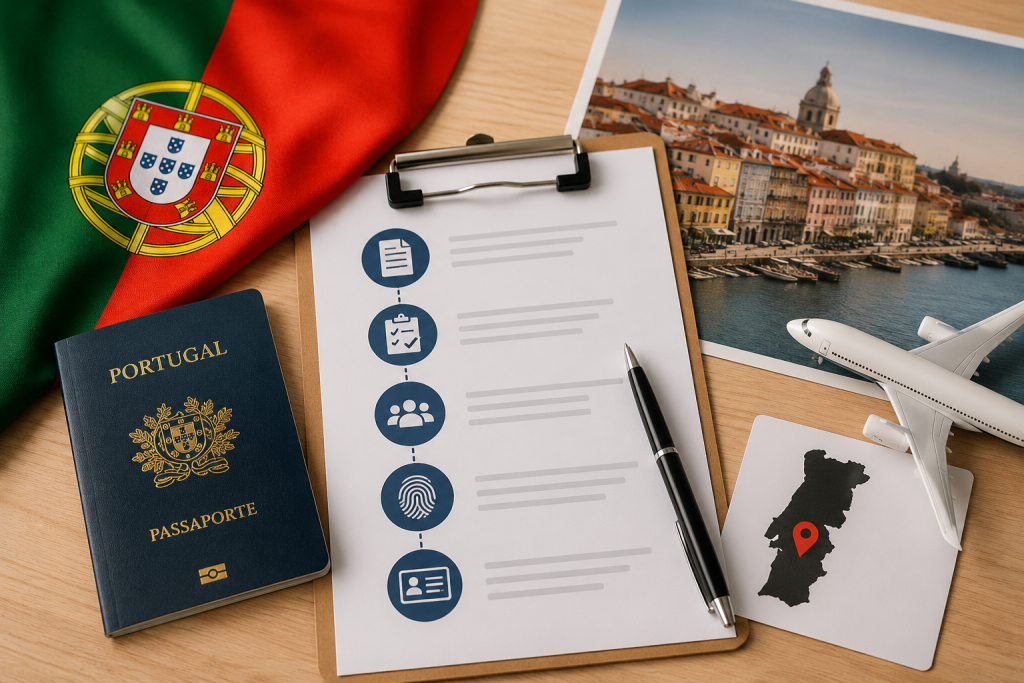
Step By Step Overview Of The Portugal Immigration Process
Because every applicant situation is different, it helps to break the Portugal immigration process into clear, manageable stages. Below is a general outline based on official published guidance.
Step one is determining the correct visa category. Before submitting anything, applicants must decide whether their situation calls for a Temporary Stay Visa or a Residency Visa. This decision shapes every later stage of the Portugal immigration process, so it deserves careful thought and, if needed, professional guidance.
Step two is gathering the required documentation. Every visa category within the Portugal immigration process requires supporting paperwork. Common documents include a valid passport, passport style photographs, proof of accommodation in Portugal, proof of sufficient financial means, travel insurance covering the initial period of stay, and a clean criminal record certificate. Depending on the specific visa subtype, additional documents such as employment contracts, university enrollment letters, or invitation letters from a hosting entity may also be required.
Step three is submitting the application at the correct location. Visa applications are generally lodged at a Portuguese consulate or an authorized external service provider in the applicant’s country of residence. Choosing the correct location is a small but important part of the Portugal immigration process, since applications submitted in the wrong jurisdiction can be delayed or rejected outright.
Step four is attending the biometric appointment. Nearly every long stay visa category requires the applicant to appear in person so that biometric data, including fingerprints and a photograph, can be captured and entered into the visa system. This biometric step is a mandatory part of the Portugal immigration process and cannot be skipped or completed remotely. Because fingerprint quality directly affects how quickly biometric data is accepted, many applicants choose to have their fingerprints professionally captured before their appointment whenever a service allows it, particularly when a criminal background certificate also requires fingerprinting as supporting evidence.
Step five is waiting for a decision. Processing times vary depending on the consulate, the season, and the completeness of the submitted file. Applicants should build extra time into their plans, since rushing any stage of the Portugal immigration process tends to create more problems than it solves.
Step six, for those approved for a Residency Visa, is entering Portugal and scheduling the AIMA appointment. This is the stage that finalizes the Portugal immigration process for long term residents, converting the initial visa into an actual residence permit that can later be renewed.
The Skilled Job Seeker Visa
A newer addition to the Portugal immigration process is the Skilled Job Seeker Visa. This category was created for foreign citizens who hold specialized technical skills and want to travel to Portugal specifically to search for employment rather than arriving with a job offer already in hand. Once granted, this visa allows the holder to remain in the country to look for suitable work, and it also authorizes highly qualified professional activity until either the visa period ends or a residence permit is granted.
This option reflects how the Portugal immigration process has evolved to attract skilled professionals in categories the country considers priorities, particularly those tied to specific international occupational classifications. Anyone considering this route should confirm current eligibility criteria, since qualifying skill categories can change based on government policy.
Proof Of Means Of Subsistence
A recurring requirement throughout the Portugal immigration process is proof that the applicant can financially support themselves during their stay. This proof can come from several sources depending on the visa category, including an existing employment contract, a signed promise of employment, a service provider contract, or a formal term of responsibility issued by a hosting entity with a recognized signature. For certain highly qualified positions, the financial threshold is tied to a multiple of the applicant’s annual gross salary or a multiple of the indexed value used for social welfare support in Portugal.
This financial requirement exists to ensure that anyone completing the Portugal immigration process will not become an undue burden on public resources while they establish themselves. Applicants should gather clear, well organized proof of income or savings well before their appointment, since incomplete financial documentation is one of the most common reasons applications stall.
Special Considerations For Minors
Families relocating together should pay close attention to the rules covering minors within the Portugal immigration process. When a minor is not traveling with both parents, or is traveling with a third party, additional documentation is required. This typically includes a travel authorization signed by the parent or parents who are not present, or a court order granting permission, along with a copy of the identity document belonging to the parent who provided authorization. Certain bilateral agreements between Portugal and specific countries may adjust these requirements slightly, so families should confirm the exact rules that apply to their nationality.
Travel Insurance And Accommodation Proof
Two frequently overlooked pieces of the Portugal immigration process are travel insurance and proof of accommodation. Applicants generally need insurance that covers medical expenses and possible repatriation for the length of the initial stay. Proof of accommodation can take several forms, including a lease agreement, a hotel reservation, or a formal invitation letter from a host residing in Portugal. Missing or incomplete documentation in either category is a common and entirely avoidable cause of delay.
Document Authentication
Depending on the applicant’s country of origin, certain documents submitted as part of the Portugal immigration process may need to be authenticated or apostilled before they are accepted. This step exists to confirm that foreign documents, such as criminal record certificates or civil status records, are genuine. Applicants should check authentication requirements early, since this process can take additional weeks depending on the issuing country.
Understanding Fees And Timelines
Fees associated with the Portugal immigration process vary based on the visa category and the applicant’s nationality, and official fee schedules are published and updated periodically. Because processing timelines can shift depending on consulate workload and application volume, applicants are encouraged to begin the Portugal immigration process well ahead of their intended travel date. Waiting until the last minute significantly increases the risk of missing important deadlines tied to employment start dates, academic terms, or family plans.
The Role Of Biometrics And Fingerprinting
Biometric data collection sits at the center of nearly every stage of the Portugal immigration process. From the initial visa application to certain criminal background checks required as supporting documentation, fingerprints play a central and often underestimated role. Poorly captured or smudged fingerprints can lead to a rejected background check, which then delays the entire Portugal immigration process while the applicant tracks down a new appointment to redo the prints correctly.
This is exactly the kind of detail that trips up otherwise well prepared applicants. Many people assume any local law enforcement office can capture usable prints, only to discover later that the quality was not accepted, forcing them to start that portion of the Portugal immigration process over again. Working with a dedicated fingerprinting service that understands the standards required for international background checks can prevent this frustrating setback. At Houston Fingerprint, our team specializes in capturing clean, properly formatted fingerprints for exactly this kind of use, helping applicants avoid the single most common paperwork failure in the entire Portugal immigration process.
Common Mistakes That Slow Down Applications
Even well organized applicants sometimes stumble during the Portugal immigration process. Some of the most frequent mistakes include applying for the wrong visa category, submitting incomplete financial proof, scheduling a biometric appointment too close to the intended travel date, forgetting to authenticate required documents, and failing to confirm AIMA appointment procedures once inside Portugal. Each of these issues is avoidable with careful planning, and each one can add weeks or months to an already lengthy timeline.
Another mistake worth mentioning is underestimating how long the entire Portugal immigration process can take from start to finish. Between gathering documents, waiting for a consulate appointment, biometric processing, and eventually securing an AIMA appointment, the full journey often spans several months. Building in a buffer for unexpected delays is one of the smartest things an applicant can do.

Tips For A Smoother Experience
Applicants who want to move through the Portugal immigration process as smoothly as possible should start early, keep organized digital and physical copies of every document, confirm requirements directly with the relevant consulate or authorized service provider, and avoid submitting an application until every required document is ready. Double checking financial proof, insurance coverage, and accommodation documentation before the appointment can prevent the most common causes of delay.
It also helps to remember that rules can change. Because the Portugal immigration process is governed by evolving national legislation, requirements that applied a year ago may not be identical today. Checking current official guidance close to the actual application date, rather than relying on older information, is one of the simplest ways to avoid surprises.
Life In Portugal After Approval
Once the Portugal immigration process is complete and a residence permit has been issued, life in Portugal opens up considerably. Residence permit holders generally gain access to healthcare, education, and the ability to travel freely within the Schengen area, subject to the usual rules that apply to all Schengen residents. Many people who successfully finish the Portugal immigration process describe the paperwork stage as the hardest part, with day to day life afterward feeling far more manageable.
Renewing a residence permit typically involves periodic check ins with AIMA and continued proof that the original conditions of the visa, such as financial means or employment, are still being met. Missing a renewal window can create avoidable complications, so marking key dates on a calendar well in advance is a simple habit worth adopting early.
Special Provisions For CPLP Nationals
Citizens of countries that belong to the Community of Portuguese Language Countries, often referred to by the acronym CPLP, sometimes benefit from adjusted requirements within the broader immigration framework. Because Portugal maintains close historical and linguistic ties with these nations, certain nationals may find that specific documentation steps are simplified or that dedicated pathways exist for residency. Anyone from a CPLP member country should confirm whether these adjusted provisions apply to their particular situation before assembling a standard application, since using the correct pathway from the outset can save significant time.
The Youth Mobility Visa Option
Younger applicants have an additional avenue worth exploring before starting the standard track. The Youth Mobility Visa is designed for people within a defined age range who want to travel to Portugal for cultural exchange, short term work, or general exploration without committing to a full study or employment program right away. This option typically carries lighter documentation requirements than a standard residency application, making it an attractive starting point for people who are still deciding on their longer term plans. It can also serve as a useful trial period before pursuing a more permanent residency track later on.
Where Applications Are Lodged And Who Can Assist
Applications are typically submitted at a Portuguese consulate covering the applicant’s place of legal residence, though authorized external service providers handle intake in many locations to expand access and reduce wait times. These providers collect documents and biometric data on behalf of the consulate but do not make decisions on the application itself, since that authority remains with consular officials. Applicants should always verify which office covers their specific region before booking an appointment, as submitting paperwork through the wrong channel is a common and entirely preventable source of delay.
If An Application Is Refused
Not every application is approved on the first attempt, and understanding the available appeal mechanisms is an important part of preparing realistically for what the Portugal immigration process can involve. When a visa is refused, applicants generally receive a written explanation outlining the specific reason for the decision. From there, formal appeal channels exist for those who believe the refusal was issued in error or who can provide additional evidence addressing the stated concern. Consulting the specific guidance tied to the refusal notice, and responding within the stated deadline, gives an applicant the best possible chance of a favorable outcome on review.
Frequently Asked Questions
How long does the entire Portugal immigration process usually take?
Timelines vary widely depending on visa category, consulate workload, and how complete the initial submission is. Still, applicants should generally expect the full path from application to residence permit to span several months.
Can the visa category be changed after submission?
In most cases, applicants must reapply under the correct category rather than amend an existing submission, which is why confirming the right visa type at the very beginning matters so much.
Is professional help necessary to apply?
It is not strictly required, but many applicants choose to work with immigration consultants, document authentication services, or fingerprinting specialists to reduce the chance of costly mistakes along the way.
What happens after the residence permit is issued?
Holders generally gain access to healthcare and education, the ability to travel within the Schengen area under standard rules, and the option to renew the permit as long as conditions continue to be met.
Final Thoughts
The Portugal immigration process can feel overwhelming at first glance, but breaking it into individual steps makes it far more manageable. From choosing the correct visa category and gathering documentation, to attending a biometric appointment and eventually securing a residence permit through AIMA, each stage builds on the one before it. Applicants who prepare thoroughly, confirm requirements with official sources, and pay close attention to details like fingerprint quality tend to move through the Portugal immigration process with far fewer setbacks.
Whether you are relocating for work, study, family, or a fresh start, understanding exactly how the Portugal immigration process works before you begin is the single best way to protect your timeline and your peace of mind. And if fingerprinting is part of your background check requirements along the way, working with a service that understands international standards can make that one piece of the Portugal immigration process simple instead of stressful.