
At its core, the process of fingerprinting is a structured method of capturing a person’s unique ridge patterns from their fingertips and submitting those patterns to a designated agency for identity verification or background screening. These ridge patterns, called friction ridge skin, are unique to each individual and remain unchanged throughout a person’s lifetime.
The process of fingerprinting is used across a wide range of situations, including:
— Employment background checks for jobs in healthcare, education, or finance
— Professional licensing (real estate agents, nurses, teachers, security personnel)
— FBI background checks
— Immigration and citizenship applications
— Adoption and foster care approvals
— Firearm purchase verifications
— Volunteer programs working with children or vulnerable populations
Now, let’s walk through exactly how the process of fingerprinting works, from start to finish.
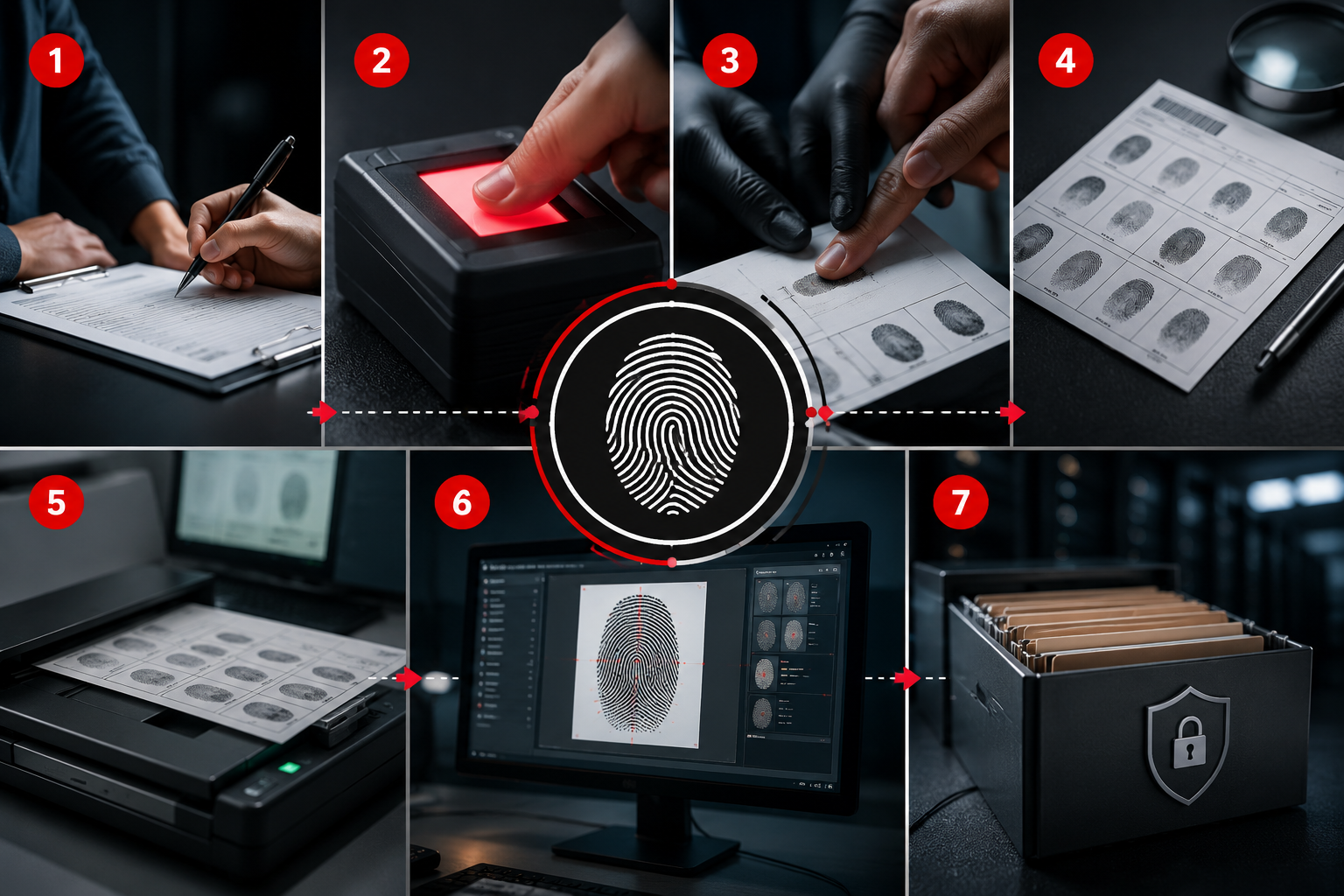
The 7 Essential Steps in the Process of Fingerprinting
Step 1 Determine the type of fingerprinting required
Before anything else, find out what kind of fingerprinting your requesting agency requires. The two most common methods are ink-and-roll (traditional card-based) and Live Scan (digital). Most modern agencies, including the FBI and Texas DPS, accept or require Live Scan. Always confirm with your employer, licensing board, or agency before scheduling.
Step 2 Gather your required documentation
The process of fingerprinting requires you to bring valid, government-issued photo identification. Acceptable forms typically include a driver’s license, state ID, passport, or military ID. Some agencies may also require an authorization form, ORI number, or reference number from the requesting organization. Double-check requirements before your appointment.
Step 3 Schedule your appointment
Locate an authorized fingerprinting service provider in your area. In Houston, providers like Houston Fingerprint offer both walk-in and scheduled appointments for your convenience. Online scheduling makes it easy to pick a time that fits your day. Booking in advance helps reduce wait times, especially during peak periods.
Step 4 Prepare your fingertips
Many people overlook this step, but it matters. On the day of your appointment, avoid lotions, hand creams, or oils on your fingers. Do not expose your hands to excessive water for long periods before your visit. Clean, dry fingertips produce the clearest ridge impressions. If your fingertips are worn (common among manual laborers), let the technician know, they can apply a conditioning solution. scheduling.
Step 5 The actual fingerprinting session
This is the core of the process of fingerprinting. A certified technician will guide each of your fingers across either an ink pad and card (for ink-roll) or a glass scanner (for Live Scan). The technician controls the pressure and rolling motion; you simply relax your hand and let them do the work. The session typically takes 5 to 15 minutes and is completely painless.
Step 6 Review and quality check
After capturing your prints, the technician reviews them for quality. Smudged, too-light, or incomplete impressions are immediately retaken at no additional charge. With Live Scan, the software can flag poor-quality captures in real time, ensuring your submission meets the standards required by the receiving agency. This quality check is a critical part of the process of fingerprinting.
Step 7 Submission and processing
Once your prints are captured and approved, they are submitted electronically (Live Scan) or mailed (ink cards) to the appropriate agency, such as the FBI, Texas DPS, or a licensing board. Processing times vary: Live Scan results can come back in as little as 24–72 hours, while ink-based cards may take 4–8 weeks, depending on the agency.
Understanding the Process of Fingerprinting: Ink Roll vs. Live Scan
One of the most common questions about the process of fingerprinting is: what’s the difference between ink roll and Live Scan?
Ink Roll Fingerprinting
The traditional process of fingerprinting uses ink applied to fingertips, which are then rolled across a paper fingerprint card. This method is still accepted by many agencies and is sometimes the only option for out-of-state submissions. The physical card is then mailed directly to the requesting agency.
Live Scan Fingerprinting
Live Scan is the modern, digital process of fingerprinting. Your fingerprints are captured on an optical scanner and transmitted electronically within minutes. It’s faster, cleaner, and produces higher-quality images. In Texas, Live Scan is the preferred method for most state background checks, professional licensing, and FBI submissions.
Which Method Is Right for You?
The right choice depends entirely on what your requesting agency accepts. When in doubt, always ask the agency directly. A trusted Houston fingerprinting provider can also help clarify which method applies to your specific situation.
How Long Does the Process of Fingerprinting Take?
The in-office portion of the process of fingerprinting is quick, usually 10 to 20 minutes from check-in to completion. Processing times after submission, however, depend on the agency:
— FBI background checks: 2–4 weeks (standard) or as fast as 2–3 business days (expedited)
— Texas DPS checks: 1–5 business days
— Federal licensing agencies: 2–8 weeks, depending on volume
Live Scan submissions are almost always faster than ink card submissions because they eliminate the mailing step entirely.
Why the Process of Fingerprinting Is Highly Reliable
Fingerprints are considered one of the most dependable biometric identifiers available. Unlike passwords or ID cards, fingerprints cannot be lost, stolen, or easily duplicated. The process of fingerprinting has been refined over more than 100 years, and modern digital scanning makes it even more accurate than ever before.
Beyond accuracy, the process of fingerprinting provides a permanent, searchable record. Once submitted to agencies like the FBI’s Integrated Automated Fingerprint Identification System (IAFIS), your prints can be quickly matched against existing records, enabling faster decisions on background checks, employment clearances, and licensing applications.
Common Reasons the Process of Fingerprinting May Need to Be Repeated
Occasionally, the process of fingerprinting needs to be redone. The most common reasons include:
— Worn or damaged fingertips (frequent for manual workers or elderly applicants)
— Poor ridge definition due to dry or cracked skin
— Smudging or excessive pressure during capture
— Rejection by the receiving agency due to quality standards
A reputable fingerprinting provider will re-capture your prints at no extra cost if quality issues arise during the session. However, if rejection occurs after submission, you may need to return for a new set of prints, so choosing an experienced, certified technician the first time matters.
The Process of Fingerprinting in Houston: What to Expect at Houston Fingerprint
At Houston Fingerprint, we make the process of fingerprinting as smooth and stress-free as possible. Our certified technicians are experienced with both ink roll and Live Scan methods and can handle submissions for employers, licensing boards, federal agencies, and immigration purposes.
We serve clients across Houston and the greater Texas area, offering:
— Flexible scheduling with online booking
— Fast turnaround for Live Scan submissions
— Guidance on documentation requirements
— Professional, courteous service every visit
Whether you’re a first-time applicant or need a quick reprint, we’re here to walk you through every step of the process of fingerprinting with care and efficiency.
Final Thoughts
The process of fingerprinting doesn’t have to be confusing or stressful. With the right preparation, knowing what to bring, understanding which method applies to you, and working with a qualified provider, the entire experience can be completed in under 20 minutes.
From job seekers to license applicants to immigration petitioners, millions of people go through the process of fingerprinting every year. Now you know exactly what to expect at each stage, and how to make it go as smoothly as possible.