If you have ever wondered how long forensic fingerprinting takes, you are not alone.
Whether you need prints for a job application, a background check, an immigration filing, or a criminal investigation, timing matters a great deal.
The answer is not one single number. It depends on the method used, the agency involved, the quality of the prints captured, and the purpose behind the submission.
This guide breaks down every stage of forensic fingerprinting so you know exactly what to expect and when.
What Is Forensic Fingerprinting?
Forensic fingerprinting is the science of capturing, analyzing, and identifying fingerprints for legal, investigative, or administrative purposes.
It is one of the oldest and most trusted identification methods in the world.
The fine lines that curve, circle, and arch across our fingertips form patterns known as friction ridges. These ridges leave impressions and residues on surfaces, which can be photographed or lifted for analysis.
Forensic fingerprinting is used in criminal investigations, employment screening, immigration processing, professional licensing, and national security.
Each application comes with its own timeline.
How Long Does the Collection Appointment Take?
The first phase of forensic fingerprinting is the actual collection appointment.
This step is far quicker than most people expect.
The process itself is relatively quick and usually takes about 10 to 15 minutes from start to finish.
During a Live Scan session, a trained technician places your fingers on a digital scanner one at a time. The technician reviews the quality of each captured image and retakes any unclear prints on the spot.
This real-time quality check is one of the biggest advantages of the digital approach. It reduces the chance of rejection at the agency level and keeps your overall timeline on track.
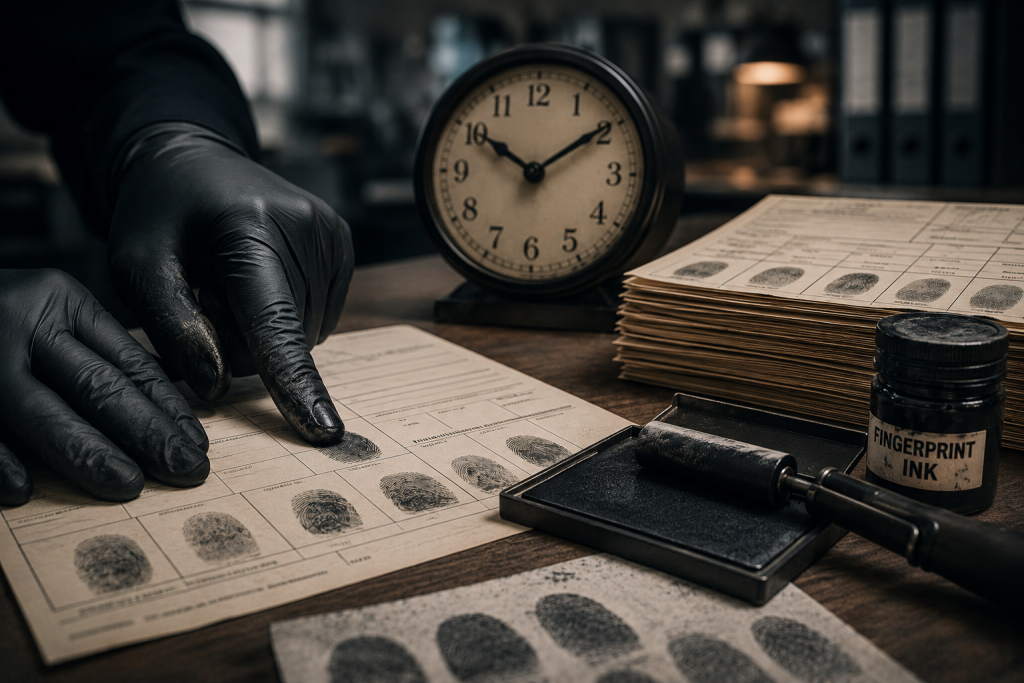
The traditional ink card method follows a similar time frame. The technician rolls each finger across an ink pad and presses it onto the card, inspecting each impression carefully before moving to the next finger.
Any required paperwork or consent forms may add a few minutes to the session.
Overall, you should plan for your entire appointment to last no longer than 30 to 60 minutes, including any wait time if you walk in without a prior booking.
Scheduling in advance is always the smartest move.
Electronic Live Scan: The Fastest Route to Results
Once the collection appointment wraps up, the digital prints are sent electronically to the appropriate agency in real time.
For Live Scan submissions, results often come back within 24 to 72 hours when everything goes smoothly.
State-level background checks, such as those processed by a state department of justice, typically return results within 1 to 7 days. In straightforward cases with clean prints and complete paperwork, results often arrive within that first 24 to 72 hour window.
Electronic submission is the gold standard for anyone who needs results quickly.
It bypasses the delays of physical mailing entirely, sending prints straight from the scanner to the database.
A rejected scan or an error on your paperwork can reset the clock entirely, which is why print quality and complete documentation matter so much from the very first moment of your session.
FBI Federal Processing: What to Expect
Many submissions require a federal background check through the FBI in addition to the state level review.
When the check requires FBI involvement, results are generally processed within 3 to 5 business days for electronic submissions.
The FBI processes requests in the order they are received and does not offer expedited handling.
Electronic submissions move significantly faster than mailed ink cards, which add physical shipping time on both ends along with manual data entry delays at the agency.
For most standard purposes, the FBI portion of the check runs alongside the state check, and both sets of results often arrive around the same time.
However, if your submission triggers a manual review or flags a potential match that requires further investigation, the timeline can stretch to 2 to 4 weeks or longer.
Traditional Ink Cards: A Slower but Sometimes Necessary Path
Not every situation allows for digital submission.
Some agencies, particularly for out of state applications or specific federal processes, still require the traditional FD-258 ink card.
For traditional ink card submissions, results typically take 2 to 4 weeks due to the need for physical mailing and manual processing.
Every stage of the ink card route adds time. The card must be mailed, received, sorted, manually entered, and then processed by the agency.
Each of those steps introduces potential delays that the electronic approach avoids entirely.
If you have the option to use Live Scan, it is almost always the faster, more reliable choice. When ink cards are required, submit them as early as possible to account for the longer turnaround.
Criminal Investigations: A More Complex Timeline
Forensic fingerprinting in the context of a criminal investigation follows a far more complex path than an employment or immigration background check.
The process begins at the crime scene, where investigators lift latent prints left behind by suspects.
Latent prints are formed by sweat, oils, and other residues that leave invisible copies of friction ridge patterns on surfaces. Once lifted, these prints enter a multi-step analysis process.
Experts compare the recovered prints to prints captured by law enforcement or stored in national databases. They then evaluate the likelihood of a match and either identify or exclude a potential suspect. Once a forensic print analyst completes their evaluation, the print goes to a separate, independent professional for verification.
It is not unusual for a print to undergo several rounds of independent verification before it is presented as evidence in court.
The automated database search itself can generate potential matches within a matter of minutes in urgent cases.
However, the full investigation, from collecting prints at the scene to completing verification and documentation, can take days, weeks, or even months depending on the complexity of the case.
This is precisely what makes forensic fingerprinting such a rigorous and respected discipline within the justice system.
Immigration and Licensing: Plan for Longer Waits
Immigration applications and professional licensing processes often require a more thorough review than a standard employment check.
How long results take depends heavily on why you need them. Employment checks can move quickly, while immigration and licensing cases may take several weeks.
USCIS and related federal agencies use fingerprint data as part of their identity verification and background screening protocols.
Complex cases, extensive histories, or any discrepancies in submitted documents can all extend the review period considerably.
If you are applying for a visa, a green card, or professional certification, start the process well ahead of any filing deadlines.
Giving yourself extra time upfront is the single best way to avoid stress later.
7 Key Timelines You Need to Know
Here is a concise reference for the most common scenarios:
1. The Collection Appointment
The appointment for forensic fingerprinting takes 10 to 30 minutes depending on the method and required paperwork.
2. Live Scan State Submission
Electronic state submissions typically return results within 24 to 72 hours.
3. FBI Federal Check via Live Scan
Electronic FBI submissions take around 3 to 5 business days to process.
4. Ink Card State Submission
Traditional ink card submissions to state agencies take 1 to 4 weeks.
5. Ink Card FBI Submission
Mailed ink cards submitted to the FBI take 2 to 6 weeks in most cases.
6. Criminal Investigation Database Search
Automated database searches in criminal cases can return initial matches within hours.
7. Full Criminal Investigation Review
A complete analysis in a criminal case, from scene collection to court ready verification, can take weeks to several months.
What Slows Down Your Results?
Even when you prepare carefully, certain factors can introduce delays.
Poor Print Quality
The clarity of your prints has a direct impact on how quickly results arrive. Poor-quality impressions require manual review and sometimes a full resubmission, adding days or weeks to your wait.
High Submission Volume
Peak hiring seasons and high-volume periods at agencies can slow processing times across the board, even for clean, well-submitted prints.
Complex Background History
If your background check surfaces a complex history, the reviewing agency may require additional time to process and verify the information before finalizing results.
Incomplete Paperwork
Missing forms or incorrect information can halt the process entirely until corrections are submitted.
Manual Review Flags
If a potential match is flagged in the database and requires further investigation, expect the timeline to extend well beyond the standard window.
How to Get Results Faster
There are practical steps you can take to speed up the process without cutting any corners.
Choose Live Scan over ink cards whenever the option is available to you. Digital submission is faster and less prone to rejection.
Arrive at your session with clean, well-moisturized hands. Dry or calloused skin reduces print clarity and increases the chances of a resubmission being required.
Follow every instruction your technician gives during the session. Proper finger placement and relaxed pressure produce cleaner impressions.
Submit all required documentation alongside your prints. Incomplete paperwork is one of the most preventable sources of delay.
Start early. Beginning the process well ahead of your deadline gives you a safety buffer if any part of the submission needs to be repeated.
Why Print Quality Determines Everything
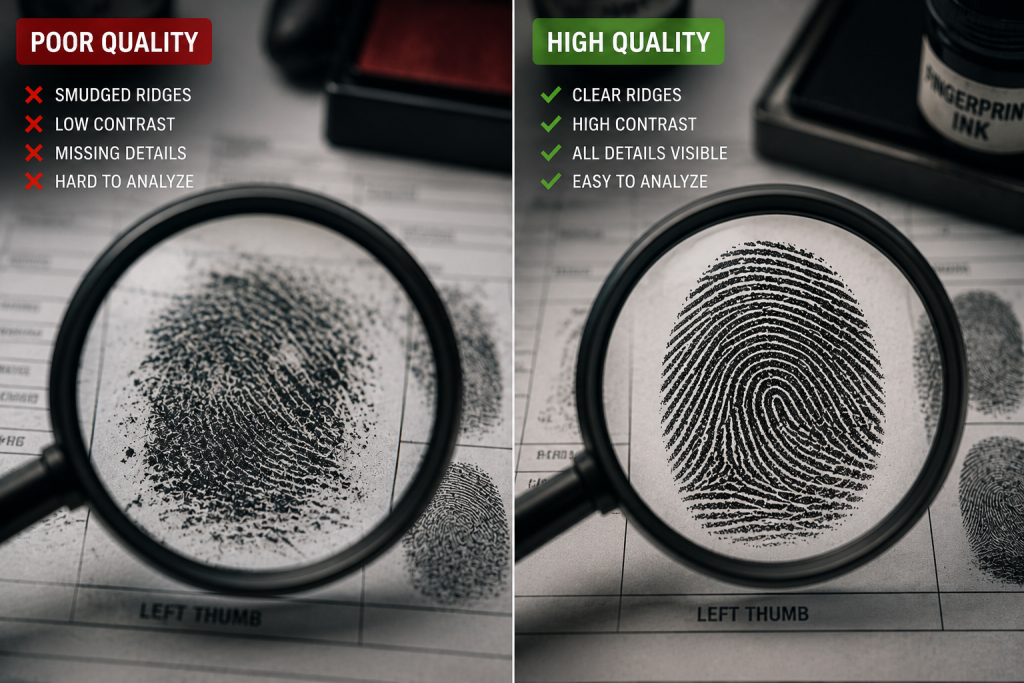
Every experienced technician will tell you that quality at the point of collection determines everything that happens downstream.
A clean, clear impression moves through the system quickly and accurately.
A smudged or incomplete print requires additional handling, manual review, and sometimes a full resubmission that resets your timeline entirely.
This is true whether you are submitting for a job, a license, an immigration application, or a criminal investigation.
At Houston Fingerprint, our forensic fingerprinting technicians are trained to capture high-quality impressions on the very first attempt. We use professional-grade equipment and follow industry best practices so your prints have the best possible chance of fast, accurate processing.
What Happens After Results Arrive?
Once the agency completes its review, results are sent directly to the requesting organization or employer.
For Live Scan submissions, you will receive a receipt with a tracking number at the time of your session. This number lets you follow up with the requesting agency if your results take longer than expected.
Keep that receipt. It is your best tool for tracking down delayed results.
If your timeline exceeds the standard window, contact the agency with your tracking number and the date of submission. Most agencies can provide a status update quickly once you have that information ready.
Is the Wait Worth It?
Fingerprints left at a crime scene represent the most common type of forensic evidence and have been used in investigations for over 100 years.
That long history of accuracy and reliability is what makes this form of identification so trusted across so many different applications.
Whether your results arrive in 24 hours or take a few weeks, the process is designed to deliver information you can count on.
Every stage, from collection to verification, exists to protect the integrity of the result.
Get Your Forensic Fingerprinting Done Right the First Time
At Houston Fingerprint, we specialize in professional forensic fingerprinting for employment, licensing, immigration, personal records, and more.
Our certified technicians ensure your prints are captured correctly and submitted without delay.
Whether you need Live Scan, ink card, or FBI certified forensic fingerprinting, we are here to make the process as fast and stress free as possible.
Visit us today and experience forensic fingerprinting done with precision, professionalism, and care.
Here are the FAQ and Final Thoughts sections to append to the end of your article, maintaining the same keyword density proportionally:
Frequently Asked Questions About Forensic Fingerprinting
1. How long does forensic fingerprinting take for a first-time applicant?
For first-time applicants, forensic fingerprinting is a straightforward and quick experience.
The collection appointment itself takes around 10 to 15 minutes.
If you are submitting electronically via Live Scan, your results can come back from the state agency within 24 to 72 hours.
First-time applicants with no prior history and clean, legible prints tend to move through the system faster than those with complex records or poor print quality.
Arriving prepared, with clean hands and all required documents, makes the biggest difference.
2. Can forensic fingerprinting results be expedited?
In most cases, the processing agency sets its own timeline and does not offer a formal expedited option.
The FBI, for example, processes forensic fingerprinting submissions in the order they are received with no priority queue available to the general public.
The most effective way to speed things up is to choose electronic Live Scan submission over ink cards, ensure your prints are captured cleanly on the first attempt, and submit complete paperwork without any missing information.
These steps will not bypass the queue, but they will prevent avoidable delays on your end.
3. What happens if my forensic fingerprinting results are rejected?
Rejection typically happens when the captured prints are too smudged, too faint, or incomplete for the agency to process accurately.
When a rejection occurs, you will need to return for a new forensic fingerprinting session and resubmit your prints.
This resets your timeline from the beginning, which is why getting it right the first time is so important.
A skilled technician with professional-grade equipment significantly reduces the risk of rejection.
At Houston Fingerprint, we take every measure to ensure your prints meet agency standards before submission.
4. Is forensic fingerprinting the same as a regular background check?
Not exactly.
A standard background check may pull records from various databases using your name, date of birth, and social security number.
Forensic fingerprinting goes a step further by using your unique biometric data to search criminal history databases with a much higher level of accuracy.
Because fingerprints are unique to every individual, this method eliminates the risk of identity confusion that can occur with name-based searches.
It is a more thorough and more reliable form of identity verification.
5. How long do forensic fingerprinting records stay on file?
Once your prints are submitted and processed, they are retained in the agency’s database according to that agency’s policies.
The FBI retains prints submitted for criminal justice purposes indefinitely.
For civil submissions, such as employment or licensing, retention policies vary by state and agency.
If you have questions about how long your specific submission will remain on file, contact the receiving agency directly for their official retention policy.
6. Do I need to redo forensic fingerprinting if I change jobs or move states?
In many cases, yes.
Different employers, licensing boards, and states each have their own requirements for forensic fingerprinting.
A clearance obtained for one employer or state may not be transferable to another.
Always check with your new employer, licensing authority, or state agency to determine whether a fresh submission is required.
Starting that process early gives you the best chance of meeting any new role or license deadlines without unnecessary stress.
7. Can weather or skin conditions affect forensic fingerprinting results?
Absolutely, and this is something many applicants overlook.
Extremely dry skin, excessive moisture, cuts, calluses, and certain skin conditions can all reduce the clarity of the prints captured during a forensic fingerprinting session.
Seasonal changes, particularly cold and dry winter months, are a common cause of poor print quality.
Moisturizing your hands in the days leading up to your appointment, staying hydrated, and avoiding harsh soaps or chemicals immediately before your session can all help produce cleaner, more accurate impressions.
Final Thoughts
Understanding how long forensic fingerprinting takes is about more than satisfying curiosity.
It is about planning ahead, setting realistic expectations, and making informed decisions about when and how to begin the process.
From a 10-minute collection appointment to a multi-month criminal investigation review, forensic fingerprinting spans a wide range of timelines depending on your specific situation.
The method you choose, the quality of your prints, the completeness of your documentation, and the agency processing your submission all play meaningful roles in determining how quickly you receive your results.
What remains constant across every single scenario is this: quality at the point of collection determines everything that follows.
A clean, accurate set of prints submitted with complete paperwork through an electronic Live Scan system is the fastest, most reliable path to timely results in virtually every context.
Cutting corners at the collection stage costs far more time than it saves.
At Houston Fingerprint, we have built our entire practice around getting forensic fingerprinting right the first time.
Our certified technicians bring skill, care, and professional-grade technology to every single appointment, whether you are submitting for employment, immigration, licensing, or any other purpose.
We understand that your time is valuable and that your results carry real weight in your life and career.
That is why we treat every forensic fingerprinting session with the same level of precision and professionalism, regardless of the purpose behind it.
If you are ready to move forward with confidence, we are ready to help.
Visit houstonfingerprint.com today to schedule your appointment and experience what accurate, professional forensic fingerprinting looks like when it is done the right way.