

If you work in the financial industry, understanding FINRA fingerprinting requirements is not optional. It is a mandatory part of joining or maintaining a position at a FINRA member firm.
Whether you are a new hire or a seasoned professional, failing to follow the FINRA fingerprinting requirements correctly can delay your career or put your firm at risk of regulatory action.
This guide breaks down every step you need to take so you can navigate the FINRA fingerprinting requirements with confidence.
What Are FINRA Fingerprinting Requirements?
FINRA fingerprinting requirements are federal mandates that apply to individuals associated with broker dealers and other registered financial firms.
Under the Securities Exchange Act of 1934, FINRA member firms must fingerprint their employees and submit those prints to the FBI for a criminal background check.
The FINRA fingerprinting requirements exist to protect investors, maintain market integrity, and ensure that people with disqualifying criminal histories are not placed in positions of trust within the financial industry.
Every firm that falls under FINRA oversight must comply, and non compliance can result in fines, suspensions, or even expulsion from the industry.
Who Must Comply With FINRA Fingerprinting Requirements?
Not every person at a financial firm is subject to FINRA fingerprinting requirements. The rule applies primarily to “associated persons,” which includes:
Registered representatives who deal with clients or securities transactions must comply with FINRA fingerprinting requirements without exception.
Officers, partners, and directors of member firms are also covered, regardless of whether they directly handle trades.
Back office employees who have access to funds, securities, or sensitive financial records are included under FINRA fingerprinting requirements as well.
Even clerical and administrative staff may be covered if they have access to client accounts or firm resources that could be misused.
Temporary and contract workers are not always exempt. If they perform functions that fall under FINRA oversight, the FINRA fingerprinting requirements still apply.
Understanding who is covered is step one toward full compliance with FINRA fingerprinting requirements.
Step 1: Determine If Your Role Requires Fingerprinting
Before anything else, your firm must determine which employees and applicants fall under the FINRA fingerprinting requirements.
Firms should review FINRA Rule 17f2, which outlines who qualifies as an associated person and must be fingerprinted.
If there is any uncertainty, consult your compliance officer or legal team. Getting this step right protects both the individual and the firm from unnecessary complications down the line.
Misidentifying exempt individuals can create gaps in your compliance record and expose the firm to scrutiny during audits.
Step 2: Use an Approved Fingerprinting Method
Once the covered individuals are identified, the next step is to collect fingerprints using an approved method under FINRA fingerprinting requirements.
There are two primary methods accepted: traditional ink and roll fingerprinting, and electronic or live scan fingerprinting.
Live scan fingerprinting has become the preferred method for most firms because it is faster, more accurate, and reduces the risk of rejection due to poor print quality.
Ink and roll cards are still accepted, but they carry a higher risk of being returned due to smudging or incomplete impressions.
For firms in Houston and across Texas, professional fingerprinting service providers like Houston Fingerprint offer both methods in a convenient setting that supports compliance with FINRA fingerprinting requirements.
Choosing a reliable provider ensures your prints are captured correctly the first time, reducing costly delays in the onboarding process.
Step 3: Complete the Required Paperwork
Meeting the FINRA fingerprinting requirements involves more than just submitting prints. The proper forms must accompany the submission.
The fingerprint card must be completed accurately, including the full legal name of the individual, date of birth, and Social Security number.
Any errors on the form can cause the submission to be rejected or delayed, which may create compliance issues for the firm.
Firms should establish an internal checklist to make sure all required fields are completed before submission. This is a simple step that prevents major headaches later.
Under FINRA fingerprinting requirements, incomplete submissions are not treated as valid, so attention to detail at this stage is critical.
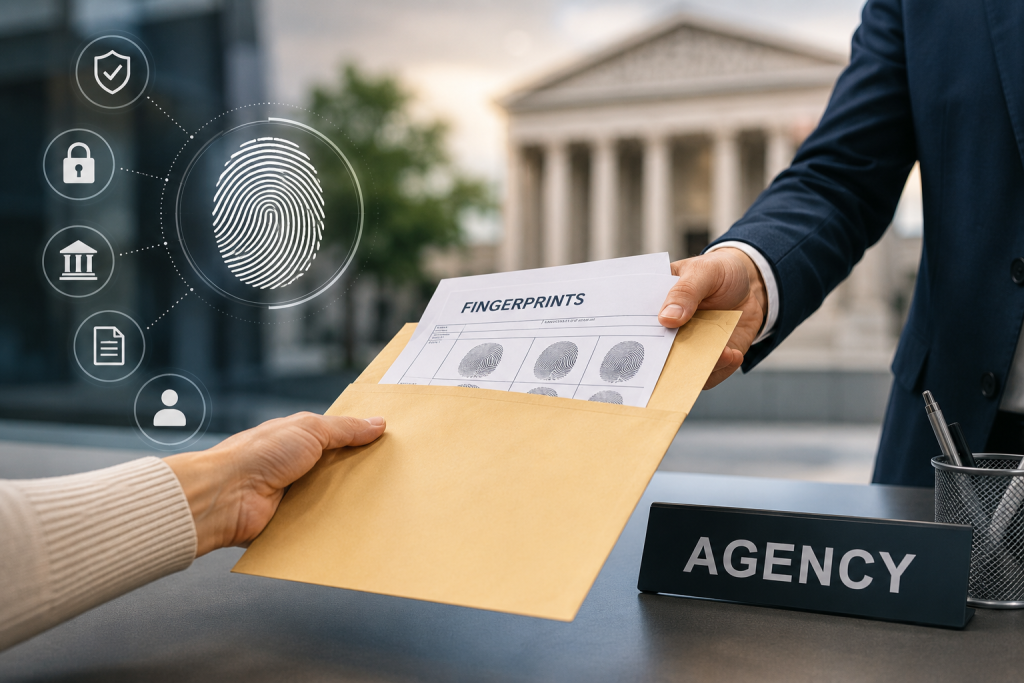
Step 4: Submit Fingerprints to the Appropriate Agency
Under FINRA fingerprinting requirements, the collected fingerprints must be submitted to the FBI through FINRA or directly via an approved channeling agent.
FINRA acts as a channeling agent, meaning it receives the fingerprint submissions from member firms and forwards them to the FBI for processing.
Firms can also work with third party vendors who are authorized to transmit fingerprint data to the FBI on behalf of the firm.
The key is ensuring that the submission goes through a compliant channel. Sending fingerprints directly to the FBI without following proper procedures does not satisfy FINRA fingerprinting requirements.
Always confirm that your vendor or internal process uses an approved pathway recognized by both FINRA and the FBI.
Step 5: Understand the Timing Rules
One of the most misunderstood aspects of FINRA fingerprinting requirements is the timing.
Firms must submit fingerprints within 30 days of the associated person beginning their employment or association with the firm.
This means the clock starts ticking on the first day of work, not on the date of hire or offer acceptance.
Missing this deadline is a direct violation of the FINRA fingerprinting requirements and can subject the firm to disciplinary action.
Some firms choose to fingerprint employees before their start date to avoid any risk of missing the deadline. This is a smart approach and is permitted under the rules.
Building a proactive onboarding process that prioritizes the FINRA fingerprinting requirements from day one is the best way to stay compliant.
Step 6: Review the FBI Background Check Results
Once fingerprints are submitted, the FBI conducts a criminal background check and returns the results to FINRA, which then notifies the firm.
The firm is responsible for reviewing these results and determining whether any disclosed criminal history constitutes a statutory disqualification under FINRA fingerprinting requirements.
A statutory disqualification means the individual is barred from associating with a FINRA member firm unless the firm applies for and receives an exemption.
Disqualifying events typically include felony convictions, certain misdemeanor convictions, and securities law violations within the past 10 years.
Firms must act promptly once results are received. Delays in reviewing or acting on background check results can compound compliance problems under FINRA fingerprinting requirements.
If a disqualification is found, the firm must consult with a compliance attorney before proceeding.
Step 7: Maintain Records and Stay Current
Compliance with FINRA fingerprinting requirements does not end after the initial submission. Ongoing recordkeeping is equally important.
Firms must retain fingerprint records for the duration of the individual’s association with the firm and for at least three years after that.
Records should include the original fingerprint submission, the results received from the FBI, and any actions taken based on those results.
FINRA conducts periodic examinations of member firms, and incomplete or missing fingerprint records are a common finding that can lead to sanctions.
It is also important to note that the FINRA fingerprinting requirements apply whenever a person rejoins a firm after a gap in association, so previous prints do not automatically carry forward.
Firms should conduct regular audits of their fingerprint records to ensure nothing has lapsed or gone unaddressed.
Common Mistakes That Violate FINRA Fingerprinting Requirements
Even well intentioned firms make mistakes that put them out of compliance with FINRA fingerprinting requirements. Here are the most frequent ones to avoid.
Waiting too long to submit prints is the most common error. Many firms delay until after onboarding paperwork is fully completed, which can push submission past the 30 day deadline.
Using a non approved fingerprinting provider is another frequent issue. Not every fingerprinting service is equipped to submit prints in a format that satisfies FINRA fingerprinting requirements.
Assuming a rehired employee does not need new prints is also a costly mistake. Unless the individual was never fully disassociated, new prints are typically required.
Failing to act on disqualifying results exposes the firm to serious regulatory consequences. Reviewing results promptly and taking appropriate action is a non negotiable part of the process.
Inadequate recordkeeping, especially at smaller firms, leaves compliance gaps that are difficult to close after the fact.
Understanding these pitfalls is essential for anyone responsible for overseeing FINRA fingerprinting requirements at their organization.
Exemptions to FINRA Fingerprinting Requirements
Not everyone associated with a FINRA member firm is subject to FINRA fingerprinting requirements. Certain exemptions exist under Rule 17f2.
Individuals who are not engaged in the securities business of the firm and who do not have access to funds, securities, or client information may be exempt.
Persons who are registered with another self regulatory organization and have already been fingerprinted through that organization may qualify for an exemption.
Foreign nationals working outside the United States may also be exempt depending on their specific role and location.
However, exemptions must be documented and justified. Simply claiming an exemption without supporting evidence is not sufficient under FINRA fingerprinting requirements.
Firms should maintain clear documentation showing the basis for any exemption claimed, in case it is challenged during a FINRA examination.
How Houston Fingerprint Supports Your Compliance
For firms based in Texas or with employees in the Houston area, working with a trusted provider simplifies the process of meeting FINRA fingerprinting requirements.
Houston Fingerprint offers professional live scan and ink roll fingerprinting services designed to support compliance with regulatory requirements like the FINRA fingerprinting requirements.
Their team understands the urgency that comes with financial industry compliance deadlines and provides fast, accurate service to help you meet the 30 day submission window.
Whether you need to fingerprint one new hire or an entire team, using a professional service reduces the risk of rejection and keeps your compliance process running smoothly.
Frequently Asked Questions About FINRA Fingerprinting Requirements
How long does FINRA fingerprint processing take?
Processing time varies, but electronic submissions via live scan are typically processed faster than paper submissions. Most results are returned within a few weeks, though complex cases may take longer.
What happens if my firm misses the 30 day deadline?
Missing the deadline is a violation of FINRA fingerprinting requirements and can result in a formal disciplinary action, fines, or a requirement to suspend the individual until compliance is achieved.
Can an individual with a criminal record work at a FINRA member firm?
It depends on the nature and timing of the conviction. Some convictions result in statutory disqualifications, while others may not. The firm must review the specific circumstances and consult compliance counsel before making a determination.
Do fingerprints ever expire?
Fingerprints themselves do not expire, but if an individual leaves a firm and later returns after a sufficient gap, new prints may be required under FINRA fingerprinting requirements.
Can small firms use the same fingerprinting service as large ones?
Yes. The FINRA fingerprinting requirements apply equally to all member firms regardless of size. Any approved provider can serve firms of any scale.
Final Thoughts on FINRA Fingerprinting Requirements
The FINRA fingerprinting requirements are a fundamental part of maintaining a trustworthy and compliant financial industry.
Following the seven steps outlined in this guide will help your firm avoid common compliance pitfalls and build a process that stands up to regulatory scrutiny.
From identifying covered individuals to reviewing results and maintaining records, each phase of the FINRA fingerprinting requirements serves an important purpose in protecting both the firm and the public.
Working with a professional fingerprinting provider, staying aware of deadlines, and building strong internal documentation habits are the keys to long term success.
If your firm operates in or near Houston, visit houstonfingerprint.com to schedule fingerprinting appointments that align with your compliance obligations under the FINRA fingerprinting requirements.
Compliance is not a one time task. It is an ongoing commitment that starts with getting the basics right.