If you have ever applied for a job, a professional license, or government clearance, chances are you were asked to complete a fingerprinting process. Most people show up ready to press their fingers on a scanner or ink pad, but few realize that the paperwork behind the process matters just as much as the prints themselves.
Understanding fingerprinting forms is one of the most overlooked parts of the entire background check process. The wrong form, a missing field, or an incorrect submission can delay your results by weeks or even result in a rejection from the requesting agency.
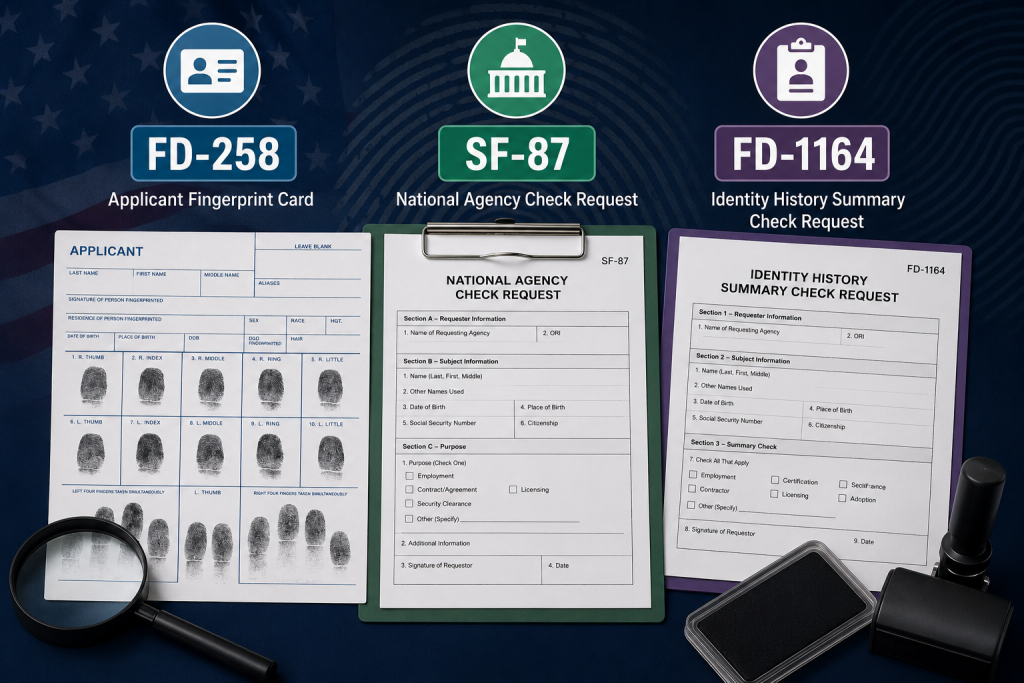
This guide breaks down the three most widely used fingerprinting forms in the United States, including FD-258, SF-87, and FD-1164. Whether you are an individual applicant or a business owner managing employee screenings, this article will give you everything you need to move forward with confidence.
Why Fingerprinting Forms Matter More Than You Think
Most people focus entirely on the fingerprinting appointment itself. They want to know how long it takes, whether it hurts, and how quickly results come back.
What they rarely think about is the documentation that travels alongside those prints.
Fingerprinting forms serve as the official record that connects your biometric data to your identity, your purpose, and the agency receiving your information. Without the correct form, your fingerprints have no context.
The FBI, federal agencies, and state licensing boards each have specific requirements for how fingerprinting forms must be completed, submitted, and processed. A mismatch between your prints and your paperwork can invalidate the entire submission.
That is why working with a professional fingerprinting provider matters. At Houston Fingerprint, we help clients navigate the exact forms required for their specific situation so nothing gets delayed or rejected.
The Three Major Fingerprinting Forms Used in the United States
There are dozens of forms used across various industries and agencies, but three stand out as the most commonly required across the country.
These are the FD-258, the SF-87, and the FD-1164.
Each of these fingerprinting forms serves a distinct purpose, is used by different agencies, and follows a unique submission process. Knowing the difference can save you significant time and frustration.
FD-258: The Most Widely Used Fingerprinting Form
What Is the FD-258?
The FD-258 is the standard fingerprint card issued by the Federal Bureau of Investigation. It is one of the oldest and most recognized fingerprinting forms in use today and remains the go-to document for a wide range of background check scenarios.
This card is a physical, ink-based document. It captures rolled fingerprints for each finger as well as flat impressions of all four fingers and the thumbs. The card also includes personal identification information such as your full legal name, date of birth, race, sex, and the reason for fingerprinting.
The FD-258 is used across countless industries and situations including employment background checks, firearms purchases, immigration applications, professional license applications, volunteer screenings, and military enlistments.
Who Requests the FD-258?
Many federal, state, and local agencies accept or require the FD-258 as their preferred card among all fingerprinting forms.
Federal employers, the Department of Justice, U.S. Citizenship and Immigration Services, the Transportation Security Administration, and numerous state licensing boards all rely on this card to process background check requests.
If your employer, licensing agency, or government office has asked you to get fingerprinted but has not specified a form, there is a strong chance the FD-258 is what they need.
How to Complete the FD-258 Correctly
Completing fingerprinting forms like the FD-258 correctly requires attention to detail. Every field must be filled in clearly and accurately.
The top portion of the card includes fields for your last name, first name, and middle name. Below that, you will find fields for your date of birth, place of birth, citizenship, race, sex, height, weight, eye color, hair color, and Social Security number.
The reason for fingerprinting field is particularly important. This tells the receiving agency why your prints are being submitted and helps route your card to the correct department.
The bottom of the card includes the signature line, the date, and in some versions, the name of the employer or agency making the request.
One of the most common reasons fingerprinting forms get rejected is illegible handwriting. Print every letter clearly in black ink.
Ink vs. Electronic Submission
The FD-258 was originally designed for ink-based fingerprinting, and many agencies still require the physical card. However, some agencies now accept livescan electronic submissions in place of traditional fingerprinting forms.
It is critical to confirm with your requesting agency whether they want a physical card or an electronic submission. Submitting the wrong format can delay your results or require you to restart the entire process.
At Houston Fingerprint, we offer both ink card and livescan services and help you determine which format your agency requires.
SF-87: Fingerprinting Forms for Federal Employment
What Is the SF-87?
The SF-87, also known as the Standard Form 87, is a fingerprint card used specifically in the context of federal employment and security clearance investigations.
Unlike the FD-258 which is used broadly, the SF-87 is one of the fingerprinting forms reserved almost exclusively for personnel security purposes within the federal government.
This form is part of a larger personnel vetting process and is typically issued directly by the hiring agency or the Office of Personnel Management. You generally cannot obtain an SF-87 on your own. It is provided to you as part of your onboarding or clearance application package.
When Is the SF-87 Required?
The SF-87 is required when a federal agency needs to conduct a national agency check as part of a background investigation for a new hire, contractor, or individual seeking a security clearance.
It often accompanies other federal forms such as the SF-86, which is the questionnaire for national security positions. Together, these fingerprinting forms and supporting documents form the foundation of a federal background investigation.
If you have accepted a position with a federal agency or are applying for a clearance level above public trust, you should expect to complete the SF-87 at some point in your onboarding.
Key Differences Between SF-87 and FD-258
Both are fingerprinting forms that capture ink rolled prints and flat impressions, but they serve different administrative channels.
The FD-258 routes through the FBI’s criminal history database, while the SF-87 is processed through federal personnel security channels and feeds into the government’s security clearance infrastructure.
You cannot substitute one for the other. Using an FD-258 when an SF-87 is required will result in a processing error and delay your investigation.
Tips for Completing the SF-87
Since the SF-87 is issued by a federal agency, most of the identifying information is either pre-filled or provided to you with specific instructions.
Follow those instructions exactly. Pay close attention to the reason for fingerprinting code, the agency identifier, and the employee identification number if applicable.
If you are unsure how to complete federal fingerprinting forms like the SF-87, the fingerprinting provider you use should be familiar with federal standards and able to guide you through the process.
FD-1164: Fingerprinting Forms for Criminal Justice and Law Enforcement
What Is the FD-1164?
The FD-1164 is a less commonly discussed but equally important member of the family of official fingerprinting forms. It is used specifically in criminal justice contexts and is primarily associated with the submission of fingerprints following an arrest or as part of an official law enforcement investigation.
This form is not something a typical job applicant or license seeker will encounter. It is used by law enforcement agencies, criminal courts, and detention facilities when recording the fingerprints of individuals who have been arrested, charged, or processed through the criminal justice system.
How the FD-1164 Differs from Other Fingerprinting Forms
While the FD-258 and SF-87 are used in voluntary, employment-related, or clearance-related scenarios, the FD-1164 exists in a different space entirely.
These are fingerprinting forms associated with criminal processing rather than personal or professional background checks.
The FD-1164 is submitted directly by law enforcement agencies to the FBI’s Next Generation Identification system, which is the national repository of criminal history records. The information captured feeds into the criminal database rather than the civil fingerprint database.
This distinction matters because the two databases are treated differently under federal privacy laws and are accessed for different purposes.
Who Handles the FD-1164?
The general public does not handle the FD-1164 directly. Law enforcement officers, booking officers at correctional facilities, and authorized criminal justice personnel are the ones responsible for completing and submitting these fingerprinting forms.
If you are involved in the criminal justice system in a professional capacity, understanding the FD-1164 is important for compliance and accuracy in record keeping.
For business owners and individuals seeking civilian background checks, this form is unlikely to be part of your process. However, understanding it helps you make sense of the broader landscape of fingerprinting forms and how the system works as a whole.
How to Know Which Fingerprinting Form You Need
One of the most common questions we hear at Houston Fingerprint is a simple one: which form do I need?
The answer depends entirely on why you are being fingerprinted and who is requesting it.
Here is a straightforward breakdown to guide you:
If you are applying for a job, volunteer position, professional license, or firearm, you almost certainly need the FD-258. This is the most universal of all fingerprinting forms and is accepted by the widest range of agencies.
If you are beginning federal employment or applying for a security clearance, you likely need the SF-87. Your hiring agency will provide this form as part of your onboarding package.
If you work in law enforcement or criminal justice and are processing an arrest or booking, the FD-1164 is the relevant form for your submission.
When in doubt, contact the requesting agency directly before scheduling your appointment. Confirm both the form required and the submission method. This single step can prevent costly delays.
Common Mistakes People Make with Fingerprinting Forms
Even when people use the correct fingerprinting forms, small errors can cause big problems. Here are the most common mistakes to avoid.
Leaving fields blank. Every field on a fingerprint card exists for a reason. Blank fields can trigger a rejection from the receiving agency. If a field does not apply to you, write N/A rather than leaving it empty.
Using the wrong name format. Always use your full legal name exactly as it appears on your government issued ID. Nicknames, shortened names, and informal spellings create mismatches in identity verification.
Smudging or poor ink quality. For ink-based fingerprinting forms, the quality of the impression matters enormously. Smudged, rolled too fast, or faint prints can result in an unclassifiable submission.
Submitting to the wrong agency. Different fingerprinting forms are sent to different agencies. Confirm the mailing address or electronic submission portal with the requesting organization before submitting.
Using expired cards. Some agencies update their fingerprinting forms periodically. Using an outdated version of a form can result in rejection. Always confirm you are using the most current version.
The Role of a Professional Fingerprinting Provider
Navigating fingerprinting forms on your own can be confusing, especially if this is your first time going through a background check or clearance process.
A professional fingerprinting provider does more than just take your prints. They help ensure the correct form is used, every field is completed accurately, and your submission meets the standards of the receiving agency.
At Houston Fingerprint, we work with individuals, businesses, and organizations across Texas to provide fast, accurate, and compliant fingerprinting services. We are familiar with the full range of fingerprinting forms required by federal, state, and local agencies.
Whether you need an FD-258 for a nursing license, an SF-87 for a federal position, or guidance on which of the fingerprinting forms applies to your unique situation, our team is here to help.
Digital Fingerprinting vs. Paper Fingerprinting Forms
Technology has changed how fingerprinting is conducted, but it has not eliminated the need for standardized fingerprinting forms entirely.
Livescan fingerprinting captures your prints electronically using a digital scanner. The images are then transmitted directly to the receiving agency without a physical card. This method is faster, more accurate, and reduces the risk of smudging or poor image quality.
However, not every agency accepts electronic submissions. Many agencies, particularly those outside major metropolitan areas or those operating under older federal systems, still require physical fingerprinting forms like the FD-258 to be mailed directly.
Some agencies accept both. In those cases, livescan is generally preferred because results come back faster and the rejection rate due to poor print quality is significantly lower.
When you schedule your appointment with Houston Fingerprint, we will confirm with you which format your agency requires and set you up accordingly.
How Long Does It Take to Get Results After Submitting Fingerprinting Forms?
Processing times vary depending on the agency, the type of background check, and the volume of submissions being handled at the time.
For most civilian background checks using the FD-258, results from the FBI typically come back within three to five business days when submitted electronically. Physical card submissions can take two to four weeks.
Federal background investigations involving the SF-87 and other fingerprinting forms can take significantly longer, especially if a full field investigation is required for a higher-level clearance. These investigations can range from a few weeks to several months.
The most important factor in getting your results back quickly is making sure your fingerprinting forms are completed correctly the first time. Errors and rejections add significant time to the process.
Conclusion: Get the Right Fingerprinting Forms the First Time
The difference between a smooth background check process and a frustrating, drawn-out experience often comes down to one thing: using the correct fingerprinting forms from the start.
The FD-258, SF-87, and FD-1164 each serve a distinct purpose within the broader fingerprinting ecosystem. Knowing which one applies to your situation, filling it out correctly, and submitting it to the right agency through the right channel is the formula for a fast, successful result.
If you are in the Houston area and need fingerprinting services, Houston Fingerprint is here to make the process simple. We handle the details so you do not have to.
Visit us at houstonfingerprint.com to schedule your appointment or learn more about how we can help with your specific fingerprinting forms and background check needs.