

When it comes to personal identification, few methods are as reliable and universally accepted as fingerprinting. At Houston Fingerprinting, we process thousands of fingerprint submissions each year, and one of the most common questions we receive is about the different types of fingerprints that exist. Whether you’re curious about the science behind fingerprint identification or need fingerprinting services for background checks, employment, or licensing purposes, understanding fingerprint patterns can provide valuable insight into this fascinating aspect of human biology.
What Makes Fingerprints Unique?
Before diving into the specific types of fingerprints, it’s important to understand what makes these patterns so special. Fingerprints are formed during fetal development, typically between the 10th and 24th weeks of pregnancy. The unique ridges and valleys that create fingerprint patterns are influenced by factors such as genetics, position in the womb, blood pressure, and even the baby’s nutrition during development. This complex combination of factors ensures that no two fingerprints are exactly alike, not even among identical twins.
The ridges on our fingertips serve a practical purpose beyond identification. They enhance our sense of touch and improve our grip on objects. From a forensic and identification standpoint, however, these ridge patterns provide an incredibly reliable method of distinguishing one individual from another.
The Three Primary Types of Fingerprints
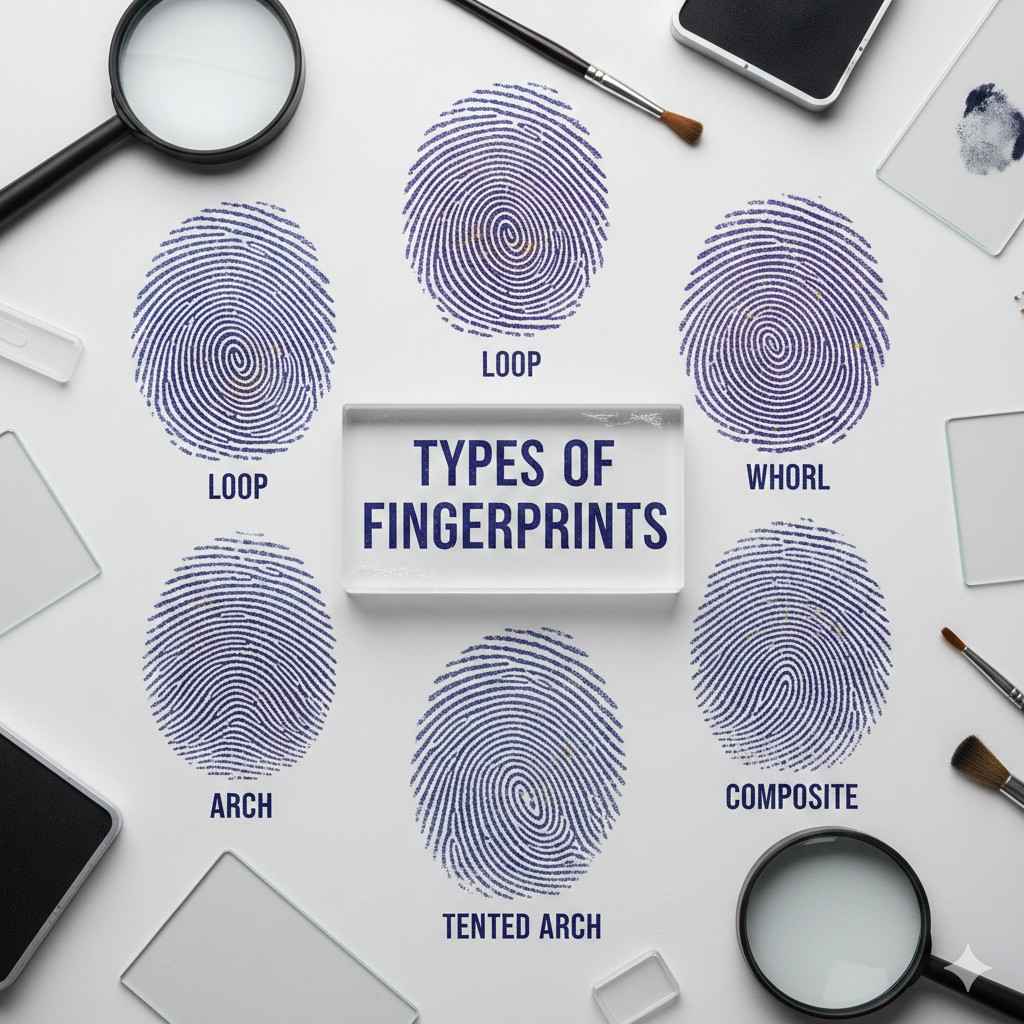
Fingerprint experts and forensic scientists have identified three main types of fingerprints based on their ridge patterns. These classifications were established over a century ago and remain the foundation of fingerprint analysis today. At Houston Fingerprinting, our trained technicians are skilled at capturing clear prints that reveal these distinctive patterns.
1. Loop Patterns
Loop patterns are the most common types of fingerprints, appearing in approximately 60 to 65 percent of the population. A loop pattern is characterized by ridges that enter from one side of the finger, curve around, and exit from the same side they entered. Think of it as a river that flows into a valley and curves back out the way it came.
There are two subtypes of loop patterns:
Radial Loops: These loops flow toward the thumb (radius bone) and are more commonly found on index fingers. The ridges enter and exit on the side closest to the thumb.
Ulnar Loops: These loops flow toward the little finger (ulna bone) and are the most prevalent of all fingerprint patterns. The ridges enter and exit on the side closest to the pinky finger.
Loop patterns are easily recognizable and provide excellent points of identification during the fingerprinting process. When clients visit Houston Fingerprinting for services, our digital scanning technology captures these loop patterns with exceptional clarity, ensuring accurate identification for background checks and official documentation.
2. Whorl Patterns
Whorl patterns are the second most common types of fingerprints, found in approximately 30 to 35 percent of the population. These patterns are characterized by circular or spiral ridge formations that create a distinctive swirling appearance. Imagine a small whirlpool or the center of a rose bloom, and you’ll have a good mental image of a whorl pattern.
Whorl patterns can be further classified into several subtypes:
Plain Whorls: These feature a circular pattern with at least two deltas (triangular ridge formations) on opposite sides of the print.
Central Pocket Loop Whorls: These combine characteristics of both loops and whorls, with a loop-like structure that contains a whorl in the center.
Double Loop Whorls: These patterns contain two separate loop formations that flow in opposite directions, creating a distinctive S-shaped or figure-eight appearance.
Accidental Whorls: These are rare patterns that combine different characteristics and don’t fit neatly into the other whorl categories.
Whorl patterns provide numerous unique points of identification, making them particularly valuable in forensic analysis and background check verification. At our Houston fingerprinting facility, we ensure that the complex details of whorl patterns are captured accurately for all official purposes.
3. Arch Patterns
Arch patterns are the rarest types of fingerprints, occurring in only about 5 percent of the population. These patterns are characterized by ridges that enter from one side of the finger, rise in the center creating an arch or wave-like formation, and exit on the opposite side. Unlike loops, arch patterns don’t curve back on themselves, and unlike whorls, they don’t form circular patterns.
There are two main subtypes of arch patterns:
Plain Arches: These are the simplest fingerprint patterns, featuring a gentle wave-like formation. The ridges flow smoothly from one side to the other with a slight rise in the middle, resembling a hill or small mountain.
Tented Arches: These are more dramatic than plain arches, with a sharper upward thrust in the center that creates a tent-like appearance. Some tented arches may even have a small spike or upward point in the center ridge.
While arch patterns are less common, they’re just as unique and identifiable as the other types of fingerprints. When processing fingerprints at Houston Fingerprinting, we pay special attention to capturing these subtle patterns, as their simpler structure requires precise scanning to ensure all identifying characteristics are documented.
How Fingerprint Classification Works in Practice
Understanding the different types of fingerprints is just the beginning of the fingerprint identification process. When you visit Houston Fingerprinting for our services, here’s what happens:
Our trained technicians use state-of-the-art digital fingerprint scanning equipment to capture high-resolution images of all ten fingers. This technology has largely replaced the traditional ink-and-paper method, providing clearer images and eliminating the mess associated with ink.
During the scanning process, each finger is rolled from one side to the other to capture the complete ridge pattern. This rolling motion ensures that all the unique characteristics of your fingerprint types are recorded, including the loops, whorls, or arches that distinguish your prints.
Once captured, these digital prints are analyzed and classified. Modern automated fingerprint identification systems can quickly categorize prints into the three main types of fingerprints and their subtypes. However, human experts still play a crucial role in verifying accuracy and identifying the minute details that make each print unique.
Why Different Types of Fingerprints Matter
You might wonder why it’s important to classify fingerprints into different categories. The classification of fingerprint types serves several important purposes:
Efficient Database Searching: When law enforcement or background check agencies need to search massive fingerprint databases, classification by pattern type significantly narrows the search field. Instead of comparing a print against millions of possibilities, the system first identifies whether it’s a loop, whorl, or arch, immediately eliminating large portions of the database.
Quality Assurance: Understanding fingerprint patterns helps technicians ensure they’ve captured complete and usable prints. At Houston Fingerprinting, our staff is trained to recognize when a print needs to be rescanned to capture all the necessary pattern details.
Forensic Analysis: In criminal investigations, identifying the general pattern type of a partial print found at a crime scene can help investigators narrow down suspects or link multiple crime scenes together.
Statistical Research: Researchers studying genetics, fetal development, and population characteristics use fingerprint pattern data to understand inheritance patterns and developmental influences.
What to Expect During Your Fingerprinting Appointment
At Houston Fingerprinting, we’ve streamlined the fingerprinting process to make it quick, convenient, and professional. When you visit our Houston facility, you can expect:
Our experienced technicians will guide you through the digital scanning process, ensuring that all types of fingerprints are captured clearly, whether you have common loop patterns or rare arch patterns. The entire process typically takes just 10 to 15 minutes, and you’ll receive confirmation that your prints meet the quality standards required by the FBI, Texas DPS, and other agencies.
We serve clients throughout Houston and surrounding areas who need fingerprinting for various purposes, including employment background checks, professional licensing, immigration applications, adoptions, and security clearances. Regardless of your specific needs, our commitment to accuracy and customer service remains the same.
Conclusion
Understanding the different types of fingerprints—loops, whorls, and arches—provides fascinating insight into human biology and the science of identification. These unique patterns form before we’re born and remain unchanged throughout our lives, serving as a permanent form of identification that’s more reliable than any password or ID card.
Whether you’re simply curious about fingerprint science or need professional fingerprinting services in Houston, Texas, we’re here to help. At Houston Fingerprinting, we combine cutting-edge technology with experienced technicians who understand the importance of accurate fingerprint capture. We know that whether you have common loop patterns or rare arch formations, each print tells the unique story of who you are.
For convenient, professional fingerprinting services in Houston, visit us at https://houstonfingerprint.com/ or contact us to schedule your appointment today. We’re committed to providing the highest quality fingerprinting services to meet all your personal and professional needs.